The evidence-based answer: ZenCortex's core is grape seed, green tea, gymnema sylvestre, capsicum, panax ginseng, astragalus, chromium picolinate and maca root, within a 20-plus ingredient blend. The antioxidant ingredients (grape seed, green tea) and panax ginseng have the best evidence; gymnema, capsicum, astragalus and chromium have thin direct hearing evidence. Exact doses aren't disclosed.
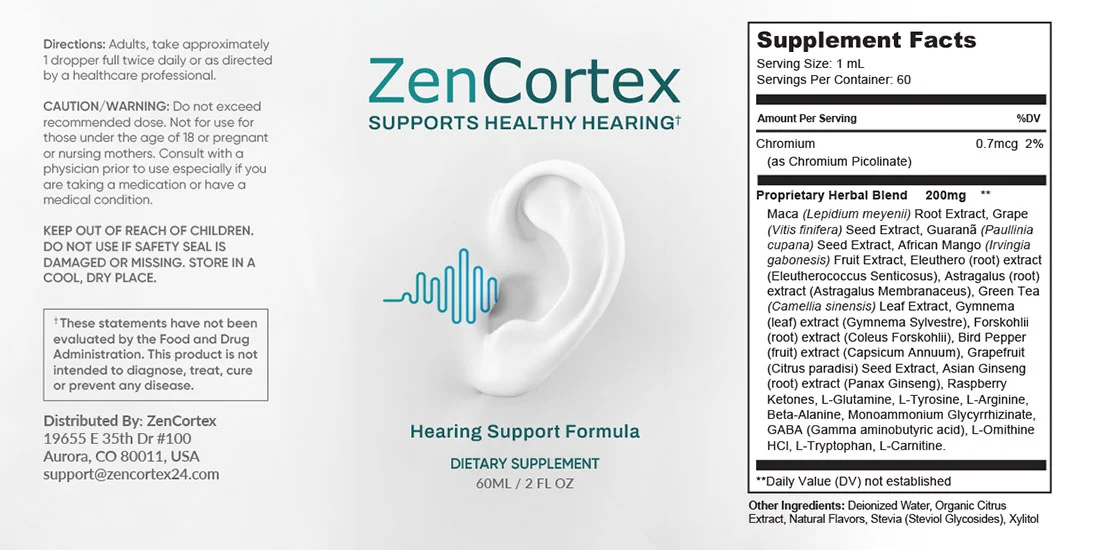
Here is the core formula, examined without the marketing gloss. For each ingredient we give the rationale, the actual evidence, and an balanced read on how much it likely contributes.
1. Grape Seed Extract
A rich source of proanthocyanidin antioxidants. The rationale in a hearing formula is that oxidative stress damages the delicate hair cells of the inner ear, and antioxidants may help protect them. A randomized trial found antioxidant supplementation reduced tinnitus loudness (PMID 31842394). Grape seed's specific human hearing evidence is limited, but its antioxidant role is well established.
2. Green Tea
Provides catechin polyphenols, notably EGCG, that act as antioxidants and are associated with healthy blood flow. In a hearing formula the logic is improved circulation to the inner ear plus free-radical protection. The direct human evidence for green tea and hearing is thin — it is best understood as antioxidant and circulatory support rather than a proven tinnitus treatment.
3. Gymnema Sylvestre
A herb best known traditionally for supporting blood sugar. Its inclusion in a hearing formula is more traditional than evidence-based; robust human trials linking gymnema to hearing or tinnitus are lacking. It is more accurate to treat this as a supporting ingredient whose auditory benefit is unproven.
4. Capsicum Annuum
Bird pepper, a source of capsaicin, included for its association with circulation and a healthy inflammatory response. Better blood flow to the inner ear is the rationale. Direct human hearing evidence is minimal, so capsicum is best viewed as a circulatory-support ingredient rather than a proven hearing agent.
5. Panax Ginseng
The ingredient with the most credible cognitive evidence in the formula. Randomized, placebo-controlled trials show Panax ginseng can support cognitive function (PMID 32235339; PMID 32055589). Since ZenCortex targets both hearing and brain, ginseng is most relevant to the cognitive-clarity side, with neuroprotective properties that may also support auditory nerve function.
6. Astragalus
A traditional adaptogenic herb. Some preliminary and traditional sources describe protective effects on auditory function after acoustic trauma, but robust modern human trials are lacking. Its antioxidant and adaptogenic properties are the rationale; the specific hearing evidence remains preliminary.
7. Chromium Picolinate
A trace mineral involved in blood-sugar regulation. Its link to hearing is indirect — stable glucose metabolism supports healthy nutrient delivery, and blood-sugar problems are associated with hearing decline. There's no direct trial evidence that chromium improves hearing; it is a supporting nutrient with an indirect rationale.
8. Maca Root
A Peruvian root traditionally used for energy, stamina and mental alertness. In ZenCortex it supports the energy-and-focus side of the formula. Its human evidence is stronger for mood and energy than for hearing specifically, so its auditory role is best described as supportive rather than direct.
The antioxidant idea, in context
The thread that ties the strongest ingredients together is antioxidants. Oxidative stress — damage from unstable free-radical molecules — is genuinely implicated in tinnitus and in age- and noise-related hearing loss. A randomized, placebo-controlled trial found that antioxidant supplementation reduced tinnitus loudness and improved tinnitus scores (PMID 31842394). Grape seed and green tea are the antioxidant workhorses in ZenCortex, which is the most scientifically grounded part of the formula.
The disclosure problem, stated plainly
ZenCortex names its ingredients but doesn't publish how much of each the dropper contains. That matters: an ingredient present only in a token amount can't do much, and without the numbers you can't tell. A clear label would list each botanical's amount. Treat the undisclosed doses as a genuine limitation when weighing this product.
It's also worth being balanced that several ingredients — gymnema sylvestre, capsicum, astragalus and chromium — have little or no direct human evidence for hearing. They are included on traditional or indirect rationale. The formula is best understood as an antioxidant-and-cognition blend with a supporting cast whose auditory benefits are largely unproven.
Safety note: Some ingredients (gymnema, chromium) may affect blood sugar. If you take diabetes or blood-pressure medication, talk to your doctor before use. This isn't a substitute for professional hearing care.
Scientific References (PubMed)
Petridou AI, et al. (2019) "The Effect of Antioxidant Supplementation in Patients with Tinnitus and Normal Hearing or Hearing Loss: A Randomized, Double-Blind, Placebo-Controlled Trial." Nutrients. PMID: 31842394
Mariage PA, et al. (2020) "Efficacy of Panax ginseng Meyer Preparation HRG80 in Preventing and Mitigating Stress-Induced Failure of Cognitive Functions: A Randomized, Double-Blind, Placebo-Controlled Crossover Trial." Pharmaceuticals (Basel). PMID: 32235339
Park KC, et al. (2019) "Cognition enhancing effect of Panax ginseng in Korean volunteers with mild cognitive impairment: a randomized, double-blind, placebo-controlled clinical trial." Transl Clin Pharmacol. PMID: 32055589
These citations refer to research on general hearing nutrition and the individual ingredients, not to the ZenCortex product itself, which has not undergone its own clinical trial. Studies often use doses or preparations different from those in this formula, and some findings are mixed. This content is educational and not medical advice; ZenCortex is not intended to diagnose, treat, cure or prevent any disease.